
- Vibe Coding: fast and accessible creativity
- Limitations of Vibe Coding
- Spec-Driven Development (SDD): the technical foundation of the project
- The role of the AI architect in SDD
- Not everyone can be a web AI architect
- Vibe Coding vs Spec-Driven Development: comparison
- How at Omitsis we enhance Spec-Driven Development with AI
- Conclusion
AI-assisted programming is transforming the way we build software. The term Vibe Coding has become popular as a synonym for fast, creative, and flexible development thanks to AI. But is it really enough to guarantee quality software?
The reality is that, in professional web development, Vibe Coding is mainly suitable for generating prototypes and simple scripts, while Spec-Driven Development (SDD) provides the technical foundation required to ensure robust, secure, and scalable software, under a hybrid AI + developer approach.
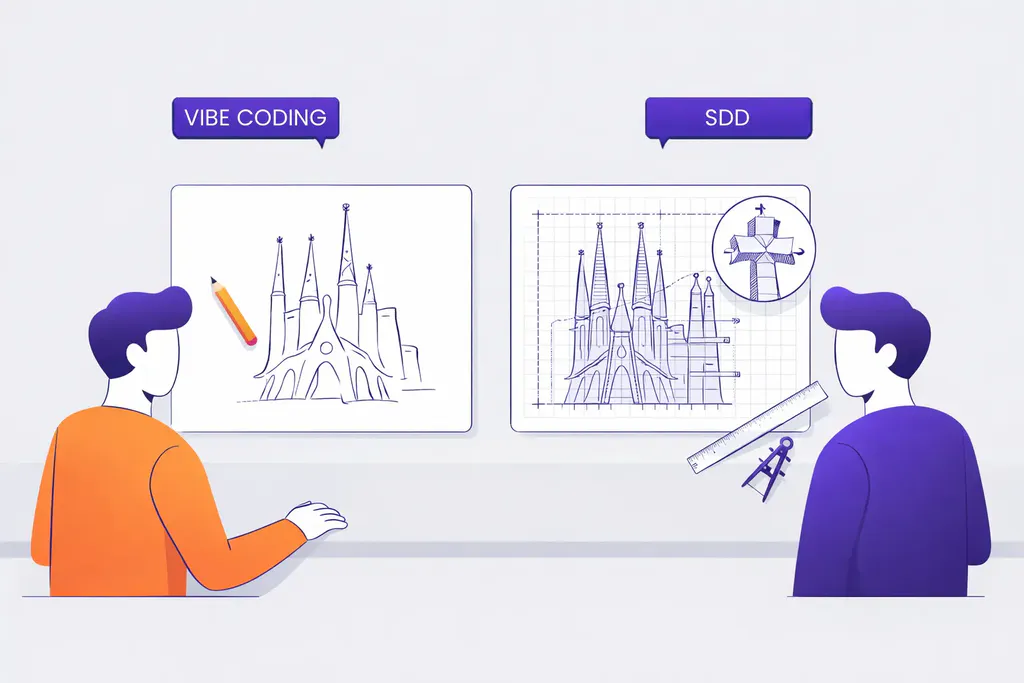
Vibe Coding: fast and accessible creativity
Vibe Coding allows us to describe in natural language what we want to achieve and lets AI generate a large part of the code. Its main advantages are:
- Speed: facilitates the creation of prototypes and proof-of-concept projects.
- Accessibility: allows developers with less experience to produce functional results.
- Creativity: enables experimentation without worrying about syntax or repetitive tasks.
However, even seemingly simple projects, such as a basic website, can become problematic if built solely with Vibe Coding, due to security risks, maintenance difficulties, or lack of architectural coherence.
Limitations of Vibe Coding
Vibe Coding is not intended for serious development. Its main limitations are:
Limited maintainability
- Spontaneously generated code that is difficult to understand or update.
- Lack of consistent design and clear architectural patterns.
- Generation of technical debt that complicates collaboration between developers.
Security risks
- Functional but potentially vulnerable code (SQL injection, insecure authentication, insufficient validation).
- Does not always handle edge cases or guarantee secure practices.
- Without human supervision, it can generate insecure software even in simple projects.
Lack of coherence
- Each AI-generated module may lack integration and a global vision.
- Design decisions are not documented or formally captured.
- Makes project evolution and onboarding of new team members difficult.
In short, Vibe Coding is useful for very simple projects or prototypes, but not for software that must be maintained, scaled, or meet professional quality standards.
Spec-Driven Development (SDD): the technical foundation of the project
Solid and controlled framework
- Ensures robustness, scalability, and coherence across the entire project.
- Forms the foundation upon which any serious development must be built.
Clear definition of objectives
- What the system must do: functionalities and expected outcomes.
- Avoids ambiguities and ensures the entire team understands the project’s intent.
Precise acceptance criteria
- Define how the success of each module or component will be measured.
- Facilitate testing, validation, and progress tracking.
Technical and architectural constraints
- Include rules that ensure consistency, scalability, and security.
- Allow AI and developers to work aligned with clear standards.
In summary, SDD transforms ideas into professional, secure, and maintainable software, providing an indispensable control framework for any serious project.
The role of the AI architect in SDD
For SDD to work correctly with AI, the project requires an AI architect:
- Designs how AI interacts with the software architecture, ensuring generated code meets specifications and coordinating integration between AI and humans.
- Defines models, prompts, data flows, and security rules so AI generates reliable code aligned with project objectives.
- Supervises and validates the code, resolves complex issues, and ensures implementation respects the defined architecture.
Without this supervision, even with SDD, software may present vulnerabilities, integration errors, or code that is difficult to maintain.
In other words, SDD requires professional structure and experienced human control; Vibe Coding alone is not enough.
Not everyone can be a web AI architect
Becoming a web AI architect is not just about learning AI tools or writing good prompts. It requires a deep foundation in programming, software architecture, and real-world web development.
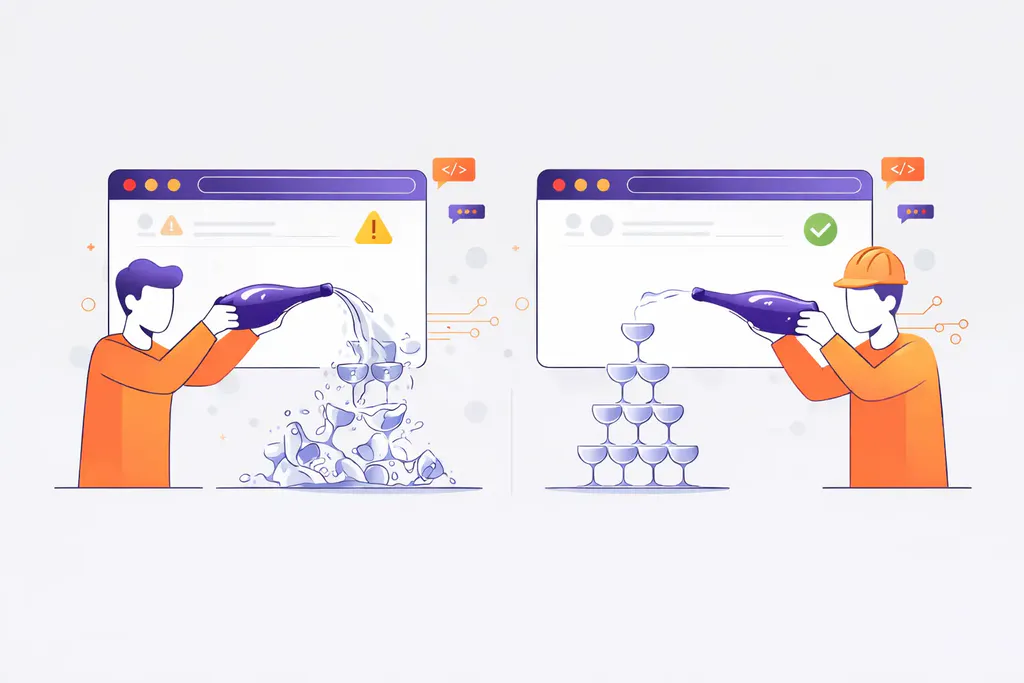
A senior web developer can naturally evolve into an AI architect because they understand how to design systems, detect risks, and validate solutions in production. The reverse process does not work: someone who masters AI without understanding web development can generate code, but not architecture or sustainable software.
The growing emergence of profiles who proclaim themselves AI architects after superficial training represents a real risk. AI does not replace technical experience: it demands even more of it. Without a solid development foundation, AI does not build better systems; it only accelerates mistakes.
Vibe Coding vs Spec-Driven Development: comparison
| Aspect | Vibe Coding | Spec-Driven Development |
|---|---|---|
| Suitable for | Prototypes and very simple projects | Serious projects, production, and critical systems |
| Maintainability | Limited | High, structured and documented code |
| Security | Risk of vulnerabilities | Integrated from the design phase |
| Architectural coherence | Low | High |
| Control and scalability | Limited | Solid and predictable |
| Supervision | Optional | AI architect + senior developers |
The key is understanding that Vibe Coding is useful for experimentation, but SDD ed by an AI architect is the essential foundation for any professional development.
How at Omitsis we enhance Spec-Driven Development with AI
At Omitsis, we combine advanced language models and AI architectures with our team’s experience to implement SDD efficiently where it truly adds value:
- We transform specifications into functional, secure, and scalable code.
- We automate testing and deployments aligned with defined criteria.
- We guarantee quality and security from the design phase.
- We combine the creativity of Vibe Coding with the technical foundation of SDD, supervised by AI architects and senior developers.
With our AI solutions, your projects benefit from Vibe Coding innovation without sacrificing security, maintainability, or control.
Conclusion
Vibe Coding is fast, creative, and accessible, but only suitable for simple projects or prototypes. For serious, critical, or production developments, Spec-Driven Development is the essential technical foundation, ensuring:
- Robustness and maintainability
- Security by design
- Architectural coherence
- Scalability and control
The smartest strategy is to use Vibe Coding to explore ideas, supported by SDD led by AI architects (with a minimum base of senior developers) to build reliable and professional software.
Discover how Omitsis can help you implement this strategy and transform your software development with AI through AI solutions.