

Magento (Magento Open Source and Adobe Commerce) ships with almost everything a store needs to rank well: clean URLs, automatic redirects, canonical tags, an XML sitemap and control over robots.txt. The problem is that, as it comes configured, it also generates thousands of duplicate URLs, mostly through layered navigation. Magento SEO is mainly about configuring what is already there and deciding which pages you want Google to index.
This is the configuration we review on the Magento stores we build and maintain, the extensions we use when the core is not enough and the mistakes we find most often.

Magento SEO configuration: what to check first
Almost everything is under Stores > Configuration > Catalog > Catalog > Search Engine Optimization:
| Setting | What it does | Recommended value |
|---|---|---|
| Use Web Server Rewrites | Removes index.php from URLs | Yes |
| Product URL Suffix / Category URL Suffix | Adds .html to the end of URLs | Pick one and never change it: changing it breaks every URL |
| Use Categories Path for Product URLs | Puts the category in the product URL | No: a product in three categories would have three URLs |
| Create Permanent Redirect for URLs if URL Key Changed | Creates a 301 when a product or category URL changes | Yes, always |
| Use Canonical Link Meta Tag For Categories / Products | Adds the canonical tag | Yes, for both |
Under Content > Design > Configuration, for each store view, review the default title and description and the Search Engine Robots section: the default robots value must be INDEX, FOLLOW in production (and NOINDEX, NOFOLLOW on staging, a mistake we have seen cost a lot of traffic).
Titles, descriptions and category copy
Magento lets you write a meta title and meta description for every product, category and CMS page, but it has no templates: with thousands of products, nobody is going to write them one by one. There are two options:
- Templates from an SEO extension, which build the title and description from attributes (name, brand, category, price), so no product is left without a description.
- Hand-written copy only where it brings business: the main categories and the best-selling products.
Categories are usually a store’s pages with the most potential, because they answer generic searches (“trail running shoes”, “ceiling lights”). A few paragraphs of original copy on a category make a real difference compared with a bare product grid.
Layered navigation: Magento’s biggest SEO problem
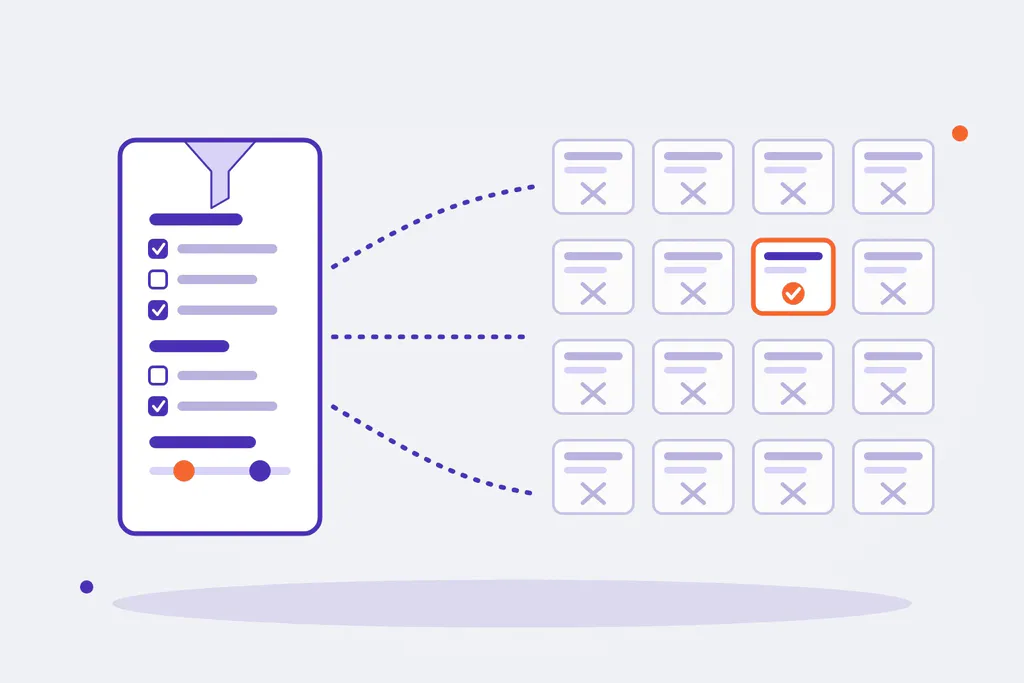
Layered navigation creates a different URL for every combination of filters: colour, size, price, brand, sort order, products per page. A category with five filters can generate thousands of nearly identical URLs. Google spends its time crawling them, does not rank them and sometimes stops crawling what matters.
The strategy we apply:
- Filtered URLs are not indexed by default: canonical to the category and
noindex, follow, so Google still follows the links to products. - Filter combinations with real demand become pages: if people search for “women’s trail running shoes”, that combination needs a clean URL, its own title and copy, and to be indexed.
- Sorting and pagination parameters (
product_list_order,product_list_limit,product_list_mode) are never indexed.
Points 1 and 3 can be solved with custom work in the theme; point 2 usually needs a layered navigation extension with SEO-friendly URLs, or custom development.
XML sitemap and robots.txt
- The sitemap is generated under Marketing > SEO & Search > Site Map and configured under Stores > Configuration > Catalog > XML Sitemap: frequency, priority, images and automatic generation by cron. Check that cron runs, because a sitemap that is not regenerated leaves new products out.
- Submit the sitemap of each store view to Google Search Console.
- In robots.txt, block what should not be crawled (internal search, cart, customer account, compare) and never the CSS and JavaScript Google needs to render the page.
Multilingual and multi-store setups
Each store view can have its own language and URLs, but Magento Open Source does not output hreflang tags out of the box. Without hreflang, Google may show the English version to a Spanish user. It is solved with an extension or custom development that links each product and category to its equivalents in the other languages.
Structured data
Product structured data (price, availability, ratings) is what makes rich results possible in Google. Magento’s default theme only includes part of it, and many custom themes lose it. The usual approach is to output JSON-LD (Product, Offer, BreadcrumbList, Organization) from the theme or with an extension, and validate it with Google’s Rich Results Test.
Performance and Core Web Vitals
Speed is a ranking factor and, above all, a conversion factor. In Magento the biggest levers are:
- Full page cache with Varnish in production.
- Images in modern formats (WebP) and sized for each device.
- JavaScript: Magento’s classic front end is heavy; themes such as Hyvä cut the weight of each page drastically.
- Hosting and database sized for the real catalogue and traffic.
Magento SEO mistakes we see often
- Changing the
.htmlsuffix or the URL structure without a redirect plan. - Products reachable from several URLs because the category path is used.
- Thousands of filter URLs indexed.
- A staging site indexed by Google, or production left on
NOINDEXafter a launch. - Out-of-stock products unpublished into 404s: it is better to keep the page, say it is out of stock and offer alternatives (whether they are shown is set under Stores > Configuration > Catalog > Inventory > Stock Options).
- Migrations from Magento 1 to Magento 2, or from another platform, without mapping the old URLs.
SEO extensions for Magento
The core covers the basics. For metadata templates, hreflang, SEO-friendly filter URLs and complete structured data, the most widespread options are suites such as Mageworx SEO Suite Ultimate or Amasty SEO Toolkit. Before installing one, check what it really solves and how it affects performance: two or three targeted changes in the theme are often lighter than a full suite.
Magento SEO with Omitsis
We have been building and maintaining Magento and Adobe Commerce stores for years, such as LedsC4, Kettal and Futbolmania, and technical SEO is part of every project: configuration, layered navigation, migrations without losing rankings, and performance. If your Magento store is not ranking as it should, tell us what is happening or see how we work on our Magento page.